

2025 has been an eventful year for South Africa’s medical oxygen sector. Following the collapse of the previous national oxygen plant tender – a process dogged by allegations of fraud, inflated costs and irregular procurement – the country relaunched the programme under far stricter oversight.
For O2Africa, which we spoke to earlier in the year about the fallout, the past twelve months have brought one of its most active periods yet, both in public health and across the wider industrial gases market.
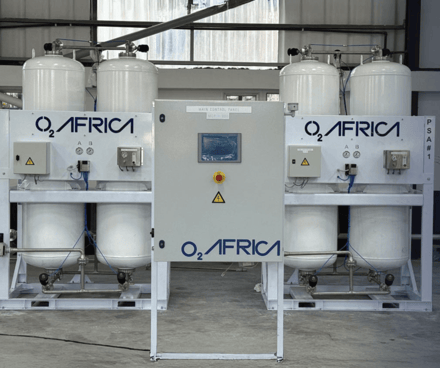
A major turning point came when the tender was split in two. The Western Cape Province opted to run its own process for ten pressure swing adsorption (PSA) oxygen plants across five hospitals. O2Africa was awarded the contract and is now building all ten systems.
“We were successful in winning the Western Cape bid,” said co-founder David Kempe. “O2Africa is currently busy with building 10 oxygen plants for five hospitals around the Western Cape, and we’re due to be completed at the end of March 2026.”
For a project that had previously sidelined local manufacturers, the result marked a major shift toward capacity built and supported within South Africa.
The rest of the national programme – covering 45 sites and 48 PSA plants – is being managed by the Development Bank of South Africa (DBSA). This tender has gone through multiple iterations during the year.
An initial expression of interest limited eligibility strictly to original equipment manufacturers, a requirement that left just two qualifying companies in the country. After industry pushback, an addendum allowed certified distributors to participate, provided they met SAHPRA (the South African Health Products Regulatory Authority) licensing rules and represented a recognised manufacturer.
“When they originally sent it out, it was only for original equipment manufacturers… I think there was some pushback and some outcry. Subsequently an addendum was released.”
A shortlist of ten companies was then issued – eight distributors of imported systems and two local OEMs. O2Africa was among them. But delivery timelines quickly became a flashpoint.
Early drafts required bidders to manufacture or import PSA plants, build concrete plinths and complete commissioning within just two months, an expectation that drew immediate concern.
“For eight distributors that had to ship products, I think this was pretty much impossible. I think they spend more time on the sea in two months,” Kempe said. “There was a lot of pushback on those timelines, and they cancelled the tender again.”
The DBSA subsequently reissued the tender, shifting to a more realistic framework. Bidders could now propose achievable schedules and bid on individual sites rather than fixed regional clusters. The emphasis moved to credible delivery timelines, with pricing negotiations expected only once technical compliance was met.
“They gave an indicative timeline of six months, but said it was up to the bidder to say what sites they can bid on,” Kempe explained. The final bids were submitted last Friday (5 December), with the DBSA planning to announce awards around 19 December.
2026 to be another “strong year”
Across O2Africa’s broader portfolio, 2025 has also been a year of expansion. The company has delivered projects in steel, mining and aquaculture and has seen rising demand in the nitrogen space. It is also growing its oxygen and nitrogen “as-a-service” model, which allows customers to avoid up-front capital costs and focus on predictable operational expenditure.
“We’ve done a lot of work… in the oxygen space, in the industrial sector, across steel, mining, aquaculture,” said Kempe. “We’re really shifting to more nitrogen and oxygen as a service going forward.”
Economic pressures remain a defining feature of the Southern African market, and on-site generation continues to gain traction as a way for businesses to manage costs.
“Everyone is always continuously looking to grow their businesses, but in a stagnant economy, always looking to reduce spend,” Kempe said. “That is still a big driving factor… how we enable our clients to reduce spend on their opex.”
On-site PSA systems, particularly when designed for local servicing, remain central to that effort.
The failures of many PSA plants deployed during the pandemic have reinforced the need for robust maintenance planning and long-term serviceability. Throughout the year, O2Africa has continued to stress the importance of standardised systems, training and accessible maintenance – factors that it believes distinguish local manufacturers from imported, highly customised plants that often struggle in the field.
©O2Africa
The strengthened procurement requirements for the new tender – including factory inspections, past-project verification and enforced service commitments – reflect many of these lessons.
Looking to 2026, O2Africa expects another strong year. The Western Cape project is underway, and the outcome of the DBSA tender could significantly expand its presence in public health infrastructure.
At the same time, industrial demand for oxygen and nitrogen systems continues to grow as companies prioritise reliability, predictable operating costs and reduced dependency on bulk or cylinder deliveries.
For South Africa, the tender relaunch in 2025 represents a broader effort to rebuild trust and establish a more transparent, technically grounded procurement model. For O2Africa, it has created the conditions for local innovation and manufacturing to play a larger role in strengthening the country’s medical oxygen supply.
As Kempe put it, “It’s been another successful year, and next year also looks like it’s accelerating at pace.”
.