

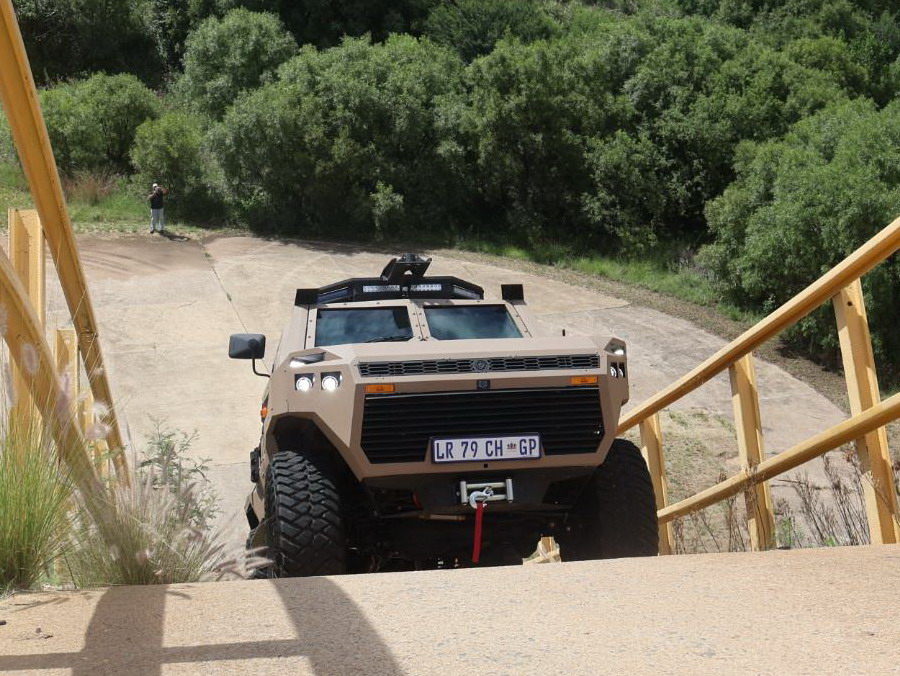
Defence and Military Veterans Minister Angie Motshekga is on the receiving end of multiple questions regarding the ‘reckless and unfair’ awarding of a personnel carrier tender to Milkor, and uncertainty over funding and delivery schedules, while Milkor insists the tender process was fair and competitive.
In October, Armscor confirmed that Milkor had been awarded tender ELWS/2024/71 for personnel carrier vehicles for border patrol, to be utilised for internal and external missions of the SA Army. A total of 462 vehicles is to be acquired, in three variants: 210 Section variants, 144 Command variants, and 108 Ambulance variants. Prototype vehicles are supposed to be delivered six months after placement of the order, with production vehicles to be delivered within three years of order placement, subject to availability of funding.
The Democratic Alliance’s Patrick George Atkinson was told by Motshekga that 462 vehicles are to be acquired at a cost of R2.793 billion, but delivery “is restricted to align with available funding.”
Only R500 million was in 2024/25 allocated by National Treasury for the new vehicles to replace the ageing Land Cruisers being used for border patrol duty under Operation Corona.
Apart from issue of funding, the tender has been criticised over the evaluation process, with field trials meant to verify vehicle performance cancelled. Local defence companies Paramount, SVI and DCD Protected Mobility had deployed their vehicles for testing in March last year when the process was halted. Milkor did not participate in the trials as it was not required to, according to Armscor. Sandock Austral also offered a vehicle, but did not make it available for trials as it was apparently deployed elsewhere in other testing activities.
The Economic Freedom Fighters’ (EFF’s) Carl Niehaus asked Motshekga if the cancellation of field trials was a deviation from the tender process. In a written reply dated 14 November, Motshekga said Armscor scheduled testing to occur post bid award and with the successful bidder only. “There were no irregularities in the process as the procurement process was in accordance with the constitutional prescripts of the procurement process.”
When he asked about the cancellation of field trials, Atkinson was informed that “the requirements are going to be physically and functionally verified against the complete specification on the winning bidder’s prototypes as part of the preliminary operational test and evaluation.”
According to Motshekga’s reply, it was decided by Armscor to execute field evaluation as follows: “Mobility Testing will be done on the preferred bidder only, at the Gerotek Testing Facility. Field Testing and Evaluation at Ndumo or Maluti Operational Area, will only be conducted on the preferred bidder, post award.”
Mothsekga gave a list of reasons for Armscor not carrying out evaluations on all bidders. The first was to avoid prolonging the process and delaying the commitment of funds, and secondly, to avoid possible litigation resulting from perceptions of unfair evaluation process due to uncontrolled conditions (e.g. weather conditions and other perceived varying conditions). She added that insurance/indemnity cover from the bidding companies “may be restrictive due to risk exposure by third parties.”
“During January 2025 the SA Army requested display/demonstration of the vehicles from bidders,” Motshekga’s reply to Atkinson reads. “The SA Army confirmed the requirement to do a Field Evaluation prior to the award of the bid. Armscor indicated that this would require Armscor Board approval as it will be a deviation from the process followed in terms of the PFMA [Public Finance Management Act]. The impact may be to the detriment of the state and may result in adverse litigation. Armscor then proceeded to issue an invitation to all bidders who complied with the critical criteria to make available the vehicle included in the bid for field evaluation by the SA Army. The evaluation was scheduled for March 2025. On 14 March 2025 Armscor issued an instruction that the field evaluation to be conducted by the SA Army be cancelled in order to align with the RFB requirements,” Motshekga stated.
A letter from Pearl Macingwane, Executive Manager: Supply Chain Management at Armscor dated 14 March 2025 to bidders read, “upon consideration of the contents of the Request for Bid (bid) that Armscor issued to industry, Armscor took a decision to cancel the field evaluations in order to align with the RFB requirements.”
“It must be noted that it was always the intention of Armscor to only provide for Field Evaluations post the award of the bid and after the delivery of the first article variants…This was clearly indicated in the RFB document, and the approach by Armscor is consistent with the provisions of the RFB document,” the Minister stated.
“The selection of the company [Milkor] as a preferred bidder was based on compliance with critical criteria and the Preferential Points System (PPS),” Motshekga explained. “The production capacity and operational experience on Personnel Carriers by the preferred bidder was verified through a site visit by Armscor and was measured against the Capability and Capacity Assessment form submitted as part of their bid.”
“Except for what was reported in the press and discussed in the various committees of Parliament, there were no official legitimate concerns [that] have been raised with the Minister,” Motshekga stated in her November reply to Niehaus.
In another reply to a question by the DA’s Nicholas Myburgh in early December, Motshekga stated that the procurement process “followed all the processes as stipulated” but she would “make a determination upon good cause shown of any irregularities” as Armscor is accountable to the Minister.
Motshekga emphasised to Atkinson that Armscor went out on a bid for personnel carriers and not armoured personnel carriers – she informed Myburgh that landmine protection was not a requirement for the bid, but ballistic protection was, and ballistic test results against 7.62×51 mm rounds (NATO STANAG Level 1) conducted by BPT in August 2024 were submitted with Milkor’s bid. The RFB states that a landmine test would be required from bidders.
Chris Hattingh, DA Spokesperson on Defence and Military Veterans, in January said Motshekga’s written reply to the DA confirms the procurement “is being handled in a way that is unfair, risky and careless with both public money and soldiers’ safety.”
“Instead of testing first and buying later, the Department has chosen to sign first and test later. That reverses basic risk management and exposes the state to serious financial and operational risk,” he stated.
“The reply further confirms that no landmine or blast testing was required or conducted as part of this tender, and that only limited small-arms ballistic testing was submitted with the bid. This means vehicles intended to carry soldiers into potentially hostile environments have not been tested against some of the most common modern threats.
“At the same time, Armscor formally instructed bidders to deploy vehicles for inspection and field trials. Established manufacturers with existing, proven vehicles already in production and exported internationally complied and deployed their platforms at significant cost. Those trials were then cancelled mid-process. The preferred bidder did not participate in any testing at all. That is not an administrative error. It is unequal treatment of bidders and a breach of the principles of fairness, competitiveness and transparency required by law.
“The Minister claims that the preferred bidder’s capacity and experience were verified, but offers no explanation for how a company with no proven history of serial production of these vehicles, and no established export record in this category, was judged capable of delivering hundreds of vehicles reliably and on time,” Hattingh stated.
Milkor has supplied armoured vehicles to Namibia, delivering several 4×4 Bushcat vehicles to the Namibian Defence Force over a year ago. Milkor said the claim that it has never supplied vehicles on an international stage is false. “We have previously supplied vehicles, similar to the ones submitted to Armscor but with modified interiors to match specifications brought forward in the tender,” a Milkor spokesperson told DefenceWeb, adding that “we do not comment on past sales as we treat it as confidential.”
Hattingh cautioned against failed defence procurement, citing the case of the Badger infantry fighting vehicle programme that has suffered years of delays, major cost overruns and repeated technical failures, wasting billions of rands while failing to deliver even a single Badger vehicle. “That should have been a warning. Instead, the Department of Defence is repeating the same mistake: committing billions before proving capability,” Hattingh said.
The DA will demand full disclosure of the evaluation process, the cancellation of trials, all deviations from the tender, and the risk assessments relied upon. “If this process cannot be shown to be lawful, fair and rational, it must be reviewed and set aside. Parliament is not a rubber stamp for reckless procurement. Soldiers’ lives and public funds deserve better than this,” he concluded.
In a letter to Motshekga dated 12 November 2025, Niehaus, as EFF permanent representative on the Portfolio Committee on Defence and Military Veterans and the Joint Standing Committee on Defence, also highlighted the vehicle testing issue, saying that under its Request for Bids, Armscor reserved the unqualified right under Clause 5.3.4 to conduct physical inspections and confirm compliance prior to contract placement with the preferred bidder. “This was not an optional step, but a non-negotiable verification gate designed to mitigate the catastrophic risks associated with deploying unproven platforms in life-threatening operational theatres.”
Niehaus stated that field testing is not a bureaucratic formality — it is the only objective mechanism to validate whether a proposed APC can survive and function in the exact conditions where SANDF soldiers will risk their lives. “The cancellation of these trials on the second day deprived the evaluation team of empirical data on four compliant platforms while granting the non-compliant bidder (Milkor) an unearned advantage,” he continued.
Niehaus called for the awarding of tender ELWS/2024/71 to Milkor to be declared irregular, set aside, cancelled and re-issued in full compliance with RFB requirements, including mandatory, noncancellable field evaluations with full SANDF participation.
He also wants the tender process investigated by the Directorate for Priority Crime Investigation (the Hawks) to ensure there was no manipulation, undue influence, and corruption.
Milkor told DefenceWeb that after evaluating the RFB carefully and understanding the scoring system and critical criteria used for the evaluation thereof, the company engaged in the tender for personnel carriers by submitting the required documentation for meeting technical specifications, and offered a competitive price.
“The entire tender process undergone by Armscor was fair and competitive and any rumoured deviations from the standard procedure for evaluation remains unsubstantiated. As stated in the RFB document, this process included the delivery of three first article variants, post the tender being awarded to a successful bidder, for field evaluations and verification to be completed. It is clear that the comments made on the award of this tender, its process or the capabilities of Milkor over the past few months are baseless, ignorant and malicious,” the Milkor spokesperson stated.
.